

Successful crisis management doesn’t just happen by accident. Being ready to meet the moment requires two things from all of us in the field of Enterprise Resiliency and Crisis Management:
- Be in a constant state of readiness. Since you won’t know the precise nature of the crisis in advance (timing, location, or specifics required at the time), those managing a crisis must always be in a constant state of readiness, as close to instantaneous as possible. Think in terms of “instant-on.”
2. Have a wide range of contingencies at your disposal so you are prepared for many possibilities. Even with all your efforts, despite prior training, plans, experience, and exercises, what you have and how you might respond may still not be enough.
Seven Essential Skills Required to Manage a Crisis
In managing any crisis, leaders must possess seven essential skills:
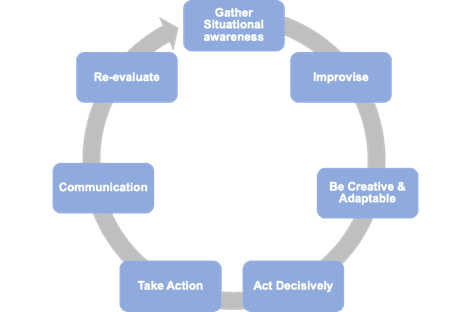
1. Situational awareness
2. Improvise
3. Be adaptable
4. Act decisively
5. Take action
6. Communicate
7. Re-evaluate
Gather Situational Awareness
Situational awareness is perhaps one of the most critical skills required in a crisis. It is the ability to identify, process, and comprehend the critical elements of information about what is happening to you and your organization in relation to the crisis. Put more simply, it’s knowing what is going on around you…even as it may be changing.
Who is responsible for collecting and updating the information? It could be one person, but it is likely a group. During an event, gather and validate the key facts of the incident. This is often done under conditions of great chaos and uncertainty. Information may be confusing or conflict with other sources. You need to obtain situational awareness from multiple sources, ideally through an automated tool or process.
Once you have the information, validate it by seeking corroborating evidence. Sometimes this means triangulating multiple sources to ensure what you’ve learned is true. In some cases, though, you may not be able to confirm the data. In that case, be sure to note it as “not confirmed.”
Improvise
In a crisis, leaders often review newly updated information, review their routine plans and checklists, and then find that their response is inadequate. They then realize that customization is required. The presence of significant novelty calls into question whether routine plans will work. This means the situation may require unplanned and unrehearsed actions to move ahead.
In a true crisis, leaders, often under extreme pressure, with high stakes and compressed timelines, must formulate a new approach to the situation. They must execute new responses or a combination of responses to manage the crisis. In other words, leaders must improvise.
“Any deep crisis is an opportunity to make your life extraordinary in some way. — Martha Beck, Author
Be Creative and Adaptable
A crisis requires approaching new problems with fresh thinking and creative, adaptable responses. Leaders must learn to recognize and appreciate the novel elements in a crisis and understand that a different approach may be required. While this may be difficult in the heat of battle, they should have practiced it in periodic exercises. Training leaders through simulations can help them develop this critical skill in a safer environment.
A leader and their team must adapt quickly to a fast-changing crisis. By its nature, a crisis evolves rapidly, and the first response will likely not be the final one. A critical thing to remember is that in a crisis, the leader cannot be wedded to a single strategy. They must continue to gather new information, listen carefully, and consult with frontline experts who know what’s happening. In other words, don’t fall in love with your own solutions and ideas.
Act Decisively
It’s the moment of truth. Someone must make a decision. Everyone knows a leader who struggles to make decisions. The inability to make a decision is a disaster within the disaster.
- Once situational awareness has been reviewed, AND
- The response has been improvised, AND
- Creativity and adaptability have been exercised THEN
- The leader must make a decision.
If, after a period of time, it becomes apparent that the wrong decision was made, make another one. The role of the leader is to keep the team and the organization moving forward. Put one foot in front of the other and keep moving.
When things are happening quickly, no one person can fully control the situation, but a leader can step in. In other words, the disaster can’t be controlled, but the response to it can be. The leader’s job is to assume the mantle of leadership and, well, lead!
“The secret of crisis management is not good vs. bad; it’s preventing the bad from getting worse.” — Andy Gilman, president & CEO of Comm Core Consulting Group
Communicate
Set realistic expectations for communication in advance — perhaps in the employee handbook, for example: Here’s what you can typically expect if there’s an emergency or challenging event in our buildings [plants, facilities, etc.]. Then communicate early and often as events unfold. Of course, the intent isn’t to alarm people, but don’t be afraid to speak to the magnitude of the situation. People need to hear what is going on, even if the news is not good. With the prevalence of social media sites, your people (or their family members or friends) will start Tweeting or posting Facebook messages that may be exaggerated or wholly false. It may take hours or days for you to set the record straight. In a worst-case scenario, the bad information could live on for weeks, months or years. (Just remember the passenger dragged off the United Airlines plane — captured on iPhones and spread worldwide in hours.)
Take Action
This is the second moment of truth: Act! Make the decision and then act on it. At this point, it’s time to implement the plans and observe the response.
One critical aspect of taking action is to ensure there are sufficient feedback loops to assess the response to the new plan and adjust accordingly. Keep checking in to determine how the plans are performing. At the same time, don’t forget to incorporate new situational awareness information and adjust accordingly.
“A crisis is an opportunity riding a dangerous wind.” — Chinese Proverb
Re-evaluate
Lastly, be prepared to conduct regular assessments at set intervals to re-evaluate and reassess progress. This allows you to tweak (or perform a major overhaul) of the plan. Ask these questions over and over:
- “How are we doing?”
- “What are we missing?”
Your job is to keep the team, the plan, the process, and the organization moving forward. That is best accomplished through effective planning, training, and exercises.
Summary
Explore these seven essential skills with your leadership and crisis management teams. Design immersive exercises that allow them to practice these skills and build muscle memory. Each of us must summon our potential and creativity to meet this moment. Work with your crisis management team(s) now to develop these skills so they will have them in the next crisis.






By the book.