
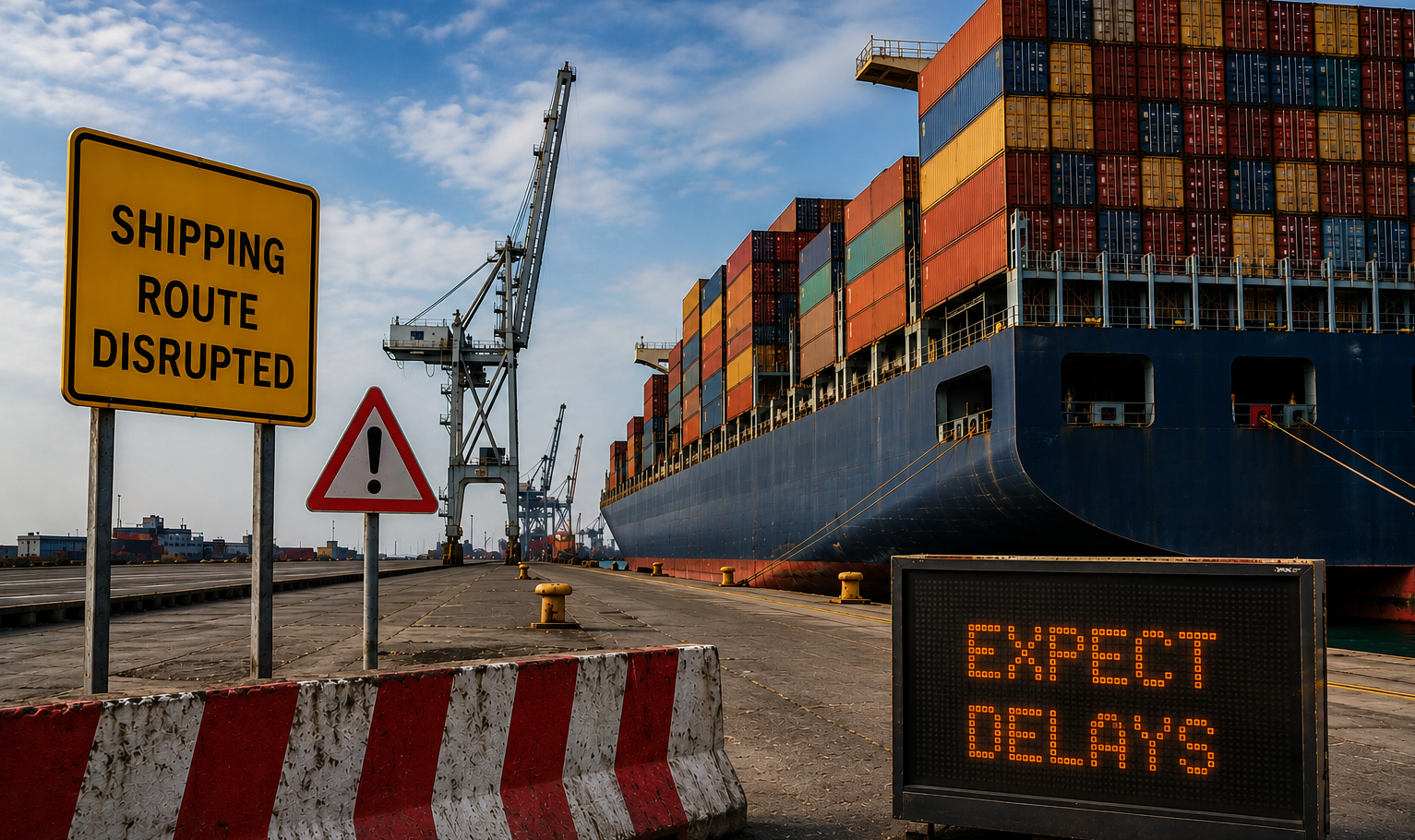
The disruption caused by the war in Iran and closure of the Strait of Hormuz has implications for business worldwide and the ripple effect has yet to fully impact operations in many locations.
This article examines the impact to date, and possible future effects, of the disruption and proposes solutions to assist business continuity planners to navigate these unprecedented events.
The recent tentative ceasefire and a temporary reduction in missile activity may appear to signal a phase of stabilization. However, beneath this surface lies a far more complex and fragile reality, one where uncertainty persists, escalation remains plausible, and every operational decision carries disproportionate consequences. The closure or disruption of critical maritime chokepoints such as the Strait of Hormuz continues to reverberate across global energy markets, supply chains, and inflation trajectories. What this conflict has made evident is not merely the vulnerability of a region, but the fragility of globally interconnected systems that rely on uninterrupted flows of energy, data, goods, and people.
The Philippines has become the world’s first country to declare a state of national energy emergency in response to the conflict in the Middle East. Nonetheless, countries across Asia and beyond are responding as part of their national resiliency efforts by implementing diverse operational continuity measures to address energy shortages and economic impacts. These measures include fuel rationing, reduced public sector operations, work-from-home mandates, travel restrictions, vehicle use limitations, school closures with online learning, and shifts in household and business practices. Additionally, efforts are focusing on diversifying trade routes and strengthening strategic partnerships to mitigate supply chain risks and enhance resilience.
The Evolving Nature of Disruption: From Localized Shocks to Systemic Conflict
Traditional notions of Business Continuity Management, often designed around localized disruptions or short-term operational shocks, appear increasingly insufficient in today’s geopolitical landscape. Modern enterprises, particularly those with manufacturing units, production facilities, or corporate hubs in geopolitically sensitive regions, must now contend with disruptions that are systemic, multi-dimensional, and prolonged. War is not a discrete event; it is an evolving condition that simultaneously affects infrastructure, workforce stability, regulatory frameworks, and market behavior. The question, therefore, is not whether organizations can recover from disruption, but whether they are structurally equipped to operate through sustained instability.
At the heart of this challenge lies a fundamental shift in how continuity must be conceptualized. Historically, business continuity plans have been anchored in scenarios such as natural disasters, IT outages, or localized facility disruptions. These events, while impactful, are typically bounded in scope and duration. In contrast, a geopolitical conflict, particularly one involving critical energy corridors, cyber warfare, and regional alliances—introduces cascading effects that transcend traditional boundaries. A missile strike is not merely a physical threat; it can disrupt power grids, destabilize telecommunications, trigger financial market volatility, and provoke regulatory interventions across jurisdictions. Similarly, a drone attack on a data center is not just an IT incident; it is a convergence of physical security, cyber risk, vendor dependency, and reputational exposure.
For corporate offices operating in or supporting the Middle East, the immediate challenge lies in ensuring workforce safety while maintaining decision-making continuity. Unlike pandemic-induced disruptions, where remote work provides a relatively stable alternative, war introduces an environment where neither physical offices nor residential spaces can be assumed safe. Organizations must therefore design continuity strategies that prioritize human safety without compromising operational command. This includes establishing distributed leadership structures, enabling cross-border command centers, and ensuring that critical decision-making capabilities are not concentrated within a single geography. The increasing reliance on Global Capability Centers in relatively stable regions such as India reflects an emerging model, one where operational control is geographically diversified to absorb regional shocks.
Manufacturing units and production facilities face an even more intricate set of challenges. These environments are inherently dependent on physical infrastructure, continuous energy supply, and tightly synchronized supply chains. In the context of the Middle East conflict, disruptions to fuel availability, transportation corridors, and utility services can rapidly translate into production downtime. Moreover, the risk is not confined to direct physical damage. A temporary airspace closure can delay critical spare parts; a cyberattack on an industrial control system can halt operations; sanctions or regulatory shifts can restrict access to essential inputs. In such scenarios, continuity cannot rely solely on reactive measures such as shutdown and restart protocols. Instead, it must be embedded within the operational architecture itself.
Need of the Hour: Building Strategic Resilience
This evolving threat landscape necessitates a transition from static, plan-based continuity to dynamic, scenario-driven strategic resilience. Organizations must move beyond generic Business Impact Analyses (BIA) and develop conflict-specific scenarios that account for the unique characteristics of war. These scenarios should not merely identify potential disruptions but map the interdependencies that amplify their impact. For instance, a disruption in maritime logistics may not only affect raw material availability but also alter pricing dynamics, strain vendor relationships, and trigger contractual disputes. Similarly, degradation in telecommunications infrastructure can impair not only internal coordination but also customer engagement and regulatory reporting.
A critical component of this approach is the identification of minimum viable operations—the set of activities that must be sustained to preserve organizational viability. For corporate offices, this may include financial transactions, regulatory communications, and customer support. For manufacturing units, it may involve maintaining baseline production levels, safeguarding critical equipment, and ensuring environmental compliance. Defining these thresholds allows organizations to prioritize resources, allocate workforce effectively, and make informed tradeoffs during periods of constraint.
Equally important is the concept of layered dependency mapping. Traditional continuity planning often focuses on first-order dependencies such as personnel, technology, and facilities. However, in a conflict scenario, second-order dependencies such as government advisories, cross-border regulatory alignments, and geopolitical alliances become equally significant. For example, the redeployment of defense systems or the imposition of sanctions can alter the operating environment in ways that are not immediately visible within organizational boundaries. By mapping these dependencies, organizations can better anticipate disruptions and design preemptive responses.
The role of supply chain resilience becomes particularly pronounced in this context. The Middle East conflict has underscored the risks associated with concentrated supply routes and single-source dependencies. Organizations that rely heavily on specific shipping lanes, air corridors, or regional vendors are inherently exposed to disruptions beyond their control. As a result, continuity strategies must incorporate diversification—not merely as a long-term strategic objective but as an operational imperative. This includes establishing alternate suppliers, rerouting logistics pathways, and pre-negotiating contingency contracts that can be activated under defined conditions.
However, resilience in a war environment is not solely a function of operational preparedness; it is equally a function of human-centered design. The psychological and emotional impact of conflict on employees cannot be underestimated. Fear, uncertainty, and personal loss can significantly affect workforce availability and performance. Organizations must therefore adopt a compassionate approach that integrates employee wellbeing into continuity planning. This involves regular communication, flexible work arrangements, and support mechanisms for employees and their families. Importantly, such measures are not merely ethical considerations; they are strategic enablers of continuity.
A critical yet often overlooked dimension in such scenarios is payroll and taxation complexity arising from workforce displacement. When employees relocate across jurisdictions or begin working remotely from different countries, organizations may face permanent establishment risks, dual taxation exposure, and compliance obligations across multiple regulatory regimes. Business continuity planning must therefore include predefined payroll protocols, alternative payment mechanisms, tax advisory support, and clear communication frameworks to ensure financial stability and regulatory adherence during disruption.
Communication, in this regard, emerges as a critical differentiator between organizations that merely survive disruption and those that maintain stakeholder trust. The Middle East conflict has demonstrated that information asymmetry and misinformation can exacerbate operational challenges. Organizations must therefore establish a disciplined communication framework that ensures consistency, transparency, and timeliness. This includes maintaining a single source of truth, aligning internal and external messaging, and leveraging multiple channels to reach diverse stakeholders. For customer-facing operations, proactive communication such as service updates, contingency options, and clear guidance can mitigate reputational damage and preserve long-term relationships.
Another dimension that warrants attention is the intersection of continuity and financial resilience. Prolonged conflict can strain liquidity, disrupt revenue streams, and alter investor sentiment. Organizations must therefore integrate financial planning into their continuity frameworks, including access to emergency funding, diversification of lenders, and mechanisms for managing currency and credit risks. Similarly, legal and contractual considerations such as force majeure clauses, sanctions compliance, and insurance coverage must be proactively addressed to avoid disputes and ensure operational flexibility.
Business continuity plans must be reevaluated to strike a balanced integration of technology and human collaboration. While digital platforms offer critical capabilities such as remote operations, data redundancy, and real-time coordination, they also create vulnerabilities through dependencies on cloud infrastructure, data centers, and telecommunications networks. Robust digital continuity strategies should ensure data sovereignty, encryption key control, and rapid data migration capabilities. Simultaneously, plans must prioritize real-time human collaboration and adaptability, leveraging human-led coordination proven effective during crises like the Middle East airspace disruption to complement technological tools. This balanced approach enhances resilience by combining the strengths of technology with the flexibility and judgment of human response in crisis management and business continuity.
As the conflict evolves, it also raises broader questions about the role of business continuity professionals within the organizational ecosystem. Traditionally positioned as custodians of plans and processes, they are now required to act as integrators of intelligence, facilitators of cross-functional coordination, and advisors to the C-suite on strategic resilience. This shift demands not only technical expertise but also a deep understanding of geopolitical dynamics, regulatory landscapes, and market behavior.
Governance & Leadership Succession Planning
Perhaps the most significant insight emerging from the Middle East conflict is the need for governance structures that can operate effectively under uncertainty. Continuity cannot be managed as a siloed function; it requires coordinated decision-making across leadership, operations, finance, legal, and communications. This, in turn, necessitates clear escalation protocols, predefined decision thresholds, and empowered leadership teams that can act decisively.
Equally important is the integration of leadership succession planning into business continuity frameworks, drawing lessons from the Iran regime. In a war scenario where leadership may become unavailable due to displacement, communication breakdown, or physical risk, organizations must ensure multiple layers of succession with clearly defined authority structures. Preauthorized decision rights, decentralized command capabilities, and cross-trained leadership teams enable continuity of governance and prevent decision paralysis during critical moments.
Conclusion
Ultimately, the lessons from the Middle East conflict point toward a redefinition of business continuity itself. While organizations may appear to be operating normally on the surface, internally they are constantly adapting—making faster decisions, taking more time in interpreting and managing risks and relying on crisis-style ways of working. It is no longer sufficient to design business continuity plans that enable recovery after disruption.
Organizations must build capabilities that allow them to operate through disruption, adapting in real time, reallocating resources, and sustaining critical functions under adverse conditions. This requires a mindset that prioritizes adaptability over predictability, integration over isolation, and preparedness over compliance.






Wow. You covered all the bases, Maitreya. The only issue I see is the apply this new perspective in BCM, you’ll need a big team. Big teams cost money – the classic ROI vs Risk dilemma. But as you stated, it starts as “…advisors to the C-suite on strategic resilience”. Thanks for sharing.