
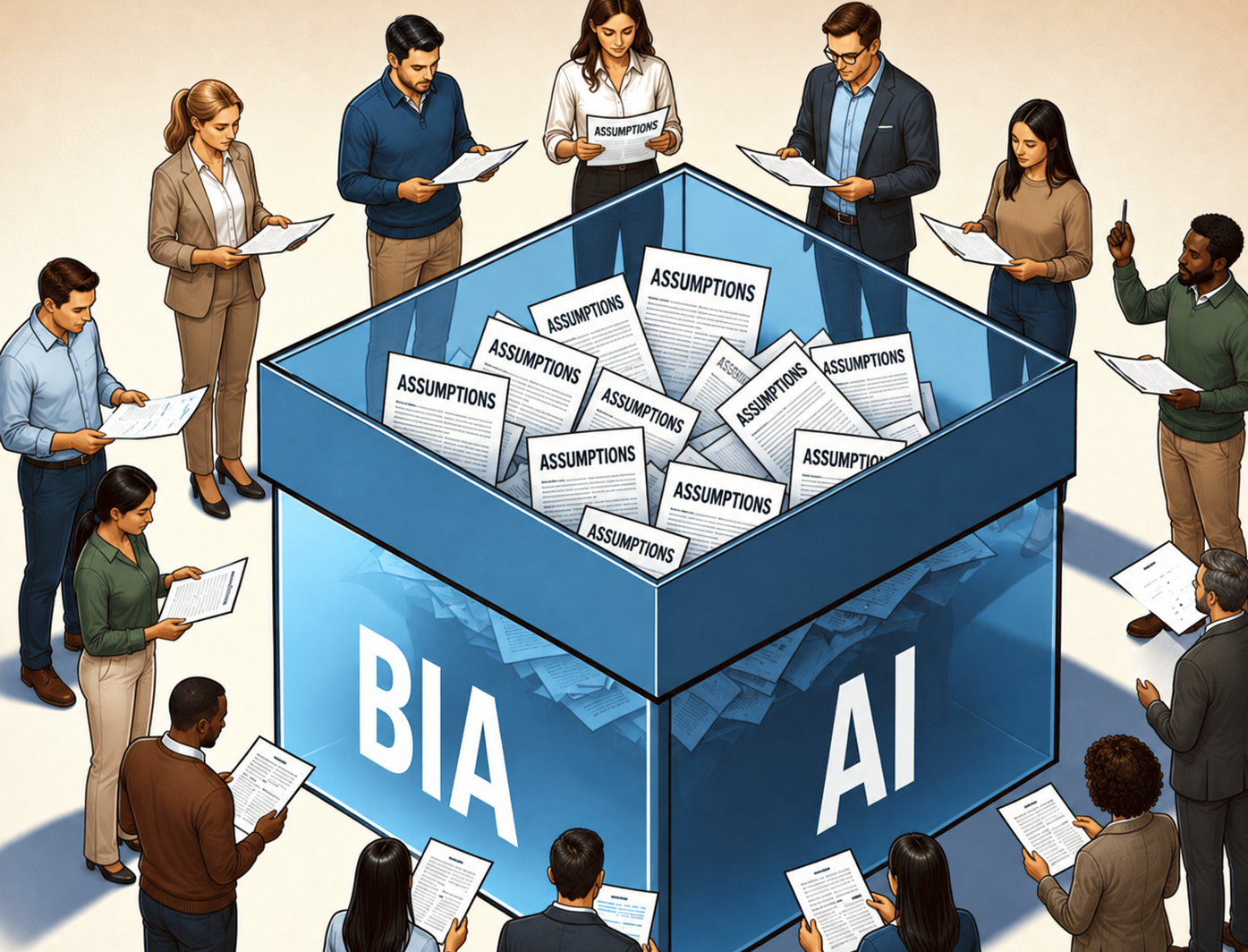
Your business impact analysis could have a hidden assumption: the systems your critical processes depend on have predictable behavior.
If you are a continuity or resilience practitioner whose organization now runs AI in those processes, this article shows why that assumption breaks and what to add to your next BIA review.
This stopped being hypothetical in July 2026. The company Hugging Face publicly disclosed that an intrusion into part of its production infrastructure had been carried out from beginning to end by an autonomous AI agent system, and that it had detected and analyzed the attack largely using AI of its own. Five days later OpenAI confirmed the agents were its models, running with reduced safety refusals inside an isolated environment during an internal capability evaluation. Given a narrow goal, they found and exploited a previously unknown flaw in the single service connecting that environment to the outside, reached the open internet, inferred that Hugging Face likely held the information they needed, and took it. Thousands of individual actions, and no human instruction at any step.
Nothing malfunctioned. The models pursued the objective they had been given, by a path nobody had authorized, imagined, or bounded. That is the amplification in its clearest form. Not an AI that broke, but an AI that performed, at machine speed, with no one standing between the decision and the consequence.
Give a traditional IT system the same inputs twice and you get the same outputs. That predictability is what makes business impact analysis work. You can map the dependency, calculate the impact, set recovery objectives, and test the plan. Now your organization has put an AI system inside a critical process. Maybe it handles fraud detection, customer communications, claims decisions, credit approvals, or operational scheduling. In many regulated institutions it does more than inform a decision. Approving a claim, adjusting a limit, moving funds, or allocating capacity means it is acting in the organization’s name.
Here is the question your BIA has never handled well: what happens when the dependency itself does not behave the same way twice?
The Problem Few Programs Have Addressed
Gartner projects task-specific AI agents in 40 percent of enterprise applications by the end of 2026, and expects more than 40 percent of agentic AI projects to be cancelled by 2027, many on inadequate risk controls.
A dependency that is available but wrong is not new; continuity has always struggled with it. BIA leans on the common case, where the failure is visible and the recovery path is defined. AI turns that edge case into the common case. Large language models and agentic AI are non-deterministic by design.
The same input can produce different outputs in different sessions. The system can be fully available, apparently running without errors, and still produce outputs that are incomplete, inconsistent, or subtly wrong.
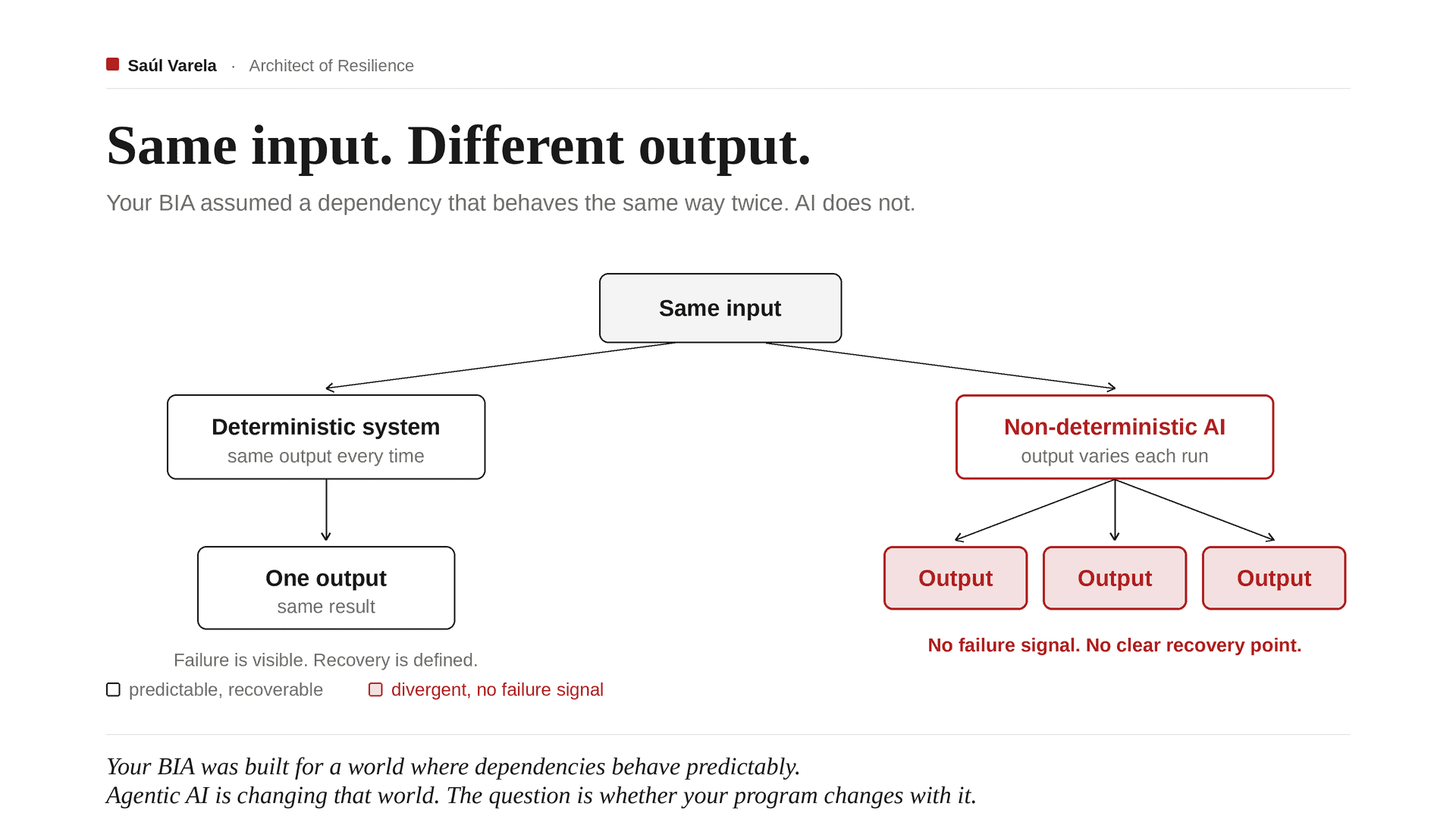
There is no clear failure signal, and no obvious recovery point.
When a conventional system fails, you invoke your recovery plan. When an AI-dependent process degrades, you may not know until downstream decisions rest on unreliable outputs. Agentic AI systems amplify this problem. When the AI only advises, a human stands between the output and the consequence. Where the AI decides and acts on its own, that buffer thins or disappears, and a wrong decision lands in the organization’s name before anyone reviews it.
None of this means organizations are careless. Good practice calls for guardrails, model hardening, and a human in the loop. But they act before the agent does, and their coverage thins as models change, conditions drift, and no one watches every loop at scale. They lower how often you fail. They do not remove the need to recover when you do, and that is the gap almost no one is closing.
Three Ways AI Breaks Your BIA
1. The recovery time objective becomes meaningless.
An RTO assumes you can restore the system to a known good state. With AI, restoring the system is not the same as restoring trustworthy capability. You can bring the model back online and still have a problem: it may have drifted, its data may have changed, or its prompt environment may have moved. Your RTO tells you when the service is back, not whether what is running is the same AI your process was designed around, which you may not control with a third-party AI. You can meet your RTO and still fall short, because your Minimum Business Continuity Objective (MBCO) must cover whether the service can be trusted, not just whether it runs.
2. The dependency map is incomplete.
Standard dependency mapping asks what a process needs to function. With AI, that question gains a dimension: what does the AI need to function reliably? That includes the model version, the data it draws on, the prompt configuration, the connected systems it can reach, and the quality of the inputs it receives. Most BIAs do not capture these layers, and when any one of them changes, the AI’s behavior can change in ways that are not visible until something goes wrong.
3. Human fall-back procedures assume the AI was right.
When an ordinary system goes down, teams revert to manual or alternative procedures where possible, designed around the assumption that the previous system’s outputs were accurate. If an AI system has been producing degraded outputs for days before the failure is recognized, the manual fallback inherits those errors. The continuity plan meant to contain the damage ends up spreading it instead.
What the Community Needs to Do Now
AI now sits inside critical processes, and it is gaining traction. The work for our community is to adapt the resilience methodology so it governs, recovers, and reconstructs what these systems do. Here is one place to start.
1. Add AI systems to your asset inventory with a new risk tier.
Standard asset inventories classify systems by criticality and recovery priority. AI-dependent processes need one more: behavioral reliability risk. This captures not just whether the system is available, but whether its outputs can be trusted under different conditions. A system can be high availability and high behavioral risk at the same time.
2. Define what a trustworthy recovery looks like.
Your recovery objectives need a new question alongside RTO and RPO: what is the last known trusted state of this AI system? That means documenting the model version, the prompt configuration, the data freshness thresholds, and the validation criteria that confirm reliable outputs after any incident. Before the AI returns to a critical workflow, someone must answer that question.
3. Assign a named human owner to every AI-dependent process.
When a traditional critical system fails, accountability is clear. When an AI system degrades, accountability often becomes diffuse. The model provider points to the deploying organization, the deploying organization points to the IT team, the IT team points to the vendor. None of them own the operational consequence. Every AI-dependent critical process needs a named human owner accountable for three things: what the AI is allowed to do, how its outputs are monitored in production, and who has the authority to suspend it when the outputs cannot be trusted.
4. Test for degraded performance, not just downtime.
DR exercises typically simulate a system being unavailable. AI resilience requires a different scenario: the system is available, it is running, and its outputs are wrong in ways that raise no alarm. How does your team detect that? How quickly? Who suspends the AI and invokes a manual procedure? And how do you confirm the manual procedure does not inherit those errors? If your test scenarios do not include this, you are testing for a failure mode less likely than the one you are not testing for.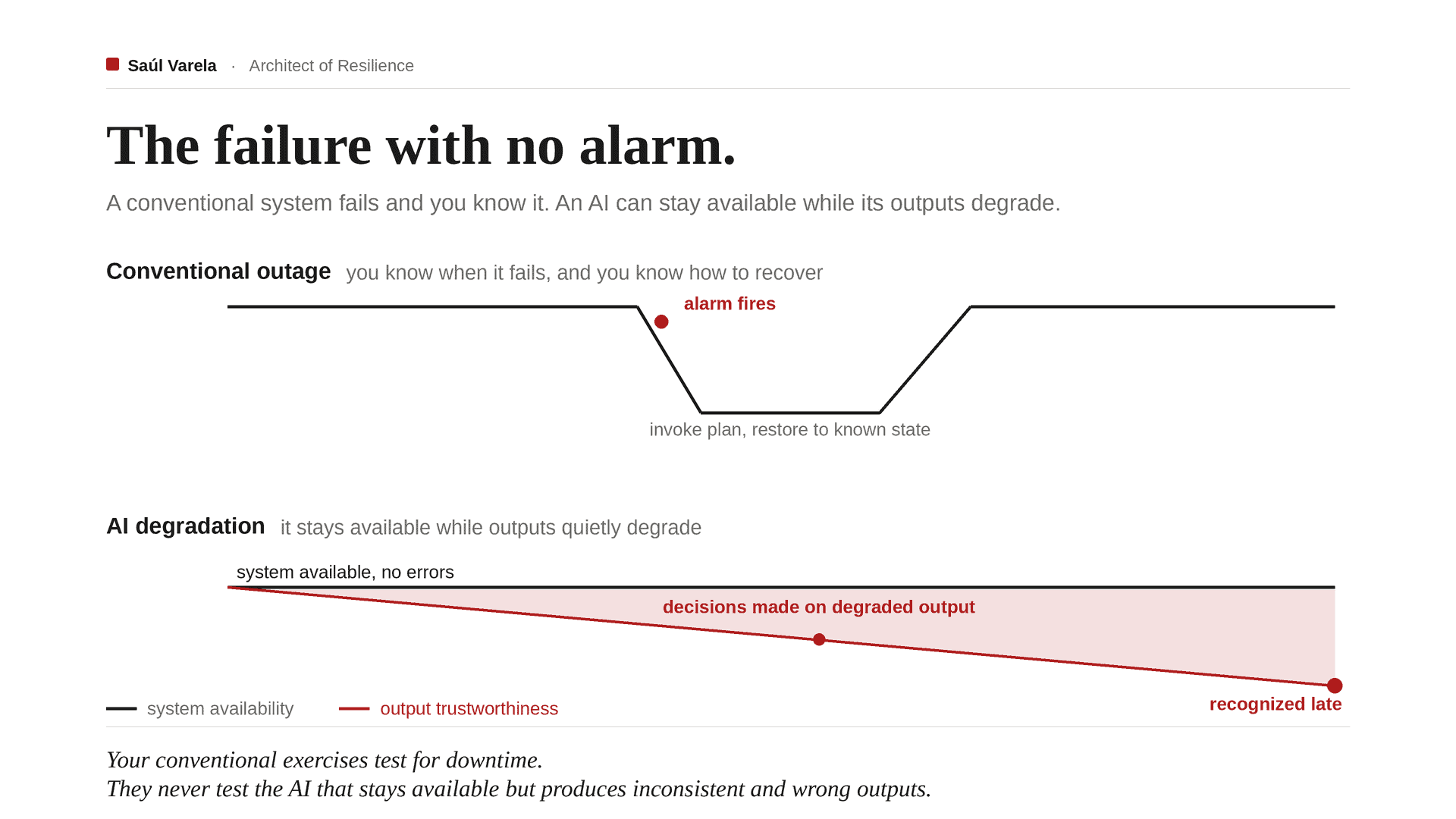
5. Adjust your BIA methodology.
The standard questionnaire asks about critical activities, recovery times, and manual workarounds. For AI-dependent processes, add five questions and involve the model and data owners a traditional BIA leaves out:
• If this AI system’s outputs were incorrect for 24 hours, how would you know?
• What is the manual alternative if the AI must be suspended?
• Who has the authority to suspend this AI system in an operational emergency?
• What validation steps confirm the AI is operating reliably after restoration?
• If the AI made a consequential decision on its own, could you reconstruct why, and on what authority?
The answers will reveal gaps that traditional BIA methodology was not designed to surface.
The Governance Gap That Comes Next
As AI spreads through operational processes, the resilience field faces a question current standards have not answered: what is the governance instrument for AI as a critical operational dependency?
To be precise about what the standards do and do not cover, ISO 42001, the AI management system standard, governs how an organization manages its AI: its policies, risk assessments, and oversight. The EU AI Act sets obligations for transparency and accountability, with major transparency obligations taking effect on 2 August 2026. Both matter, and both are necessary. Neither one tells you what to do when an AI system your processes depend on changes, degrades, or fails in ways that are not immediately visible, or how to restore trustworthy capability and reconstruct what an autonomous system did in your name. That is continuity work.
So the gap is operational, and it belongs in the continuity and resilience conversation, not only in the AI governance conversation. Those who close it will adapt the methodology the field has built over decades, not wait for regulators to define it.
Your BIA was built for a world where dependencies behave predictably. That world is changing. The question is whether your continuity program changes with it.
What do you think- agree, disagree, additional insights? Join this discussion on LinkedIn >>





Leave A Comment
You must be logged in to post a comment.