

Technology shouldn’t just support your business—it should help protect it, improve it, and prepare it for what’s next.
Unfortunately, many organizations only hear from their IT provider when something breaks or it’s time to renew a contract. That’s a missed opportunity. The best managed IT providers don’t simply resolve support tickets. They help business leaders reduce risk, improve operational resilience, plan technology investments, and strengthen cybersecurity before issues impact the business.
That’s why every organization should conduct a Quarterly IT Review, sometimes called a Quarterly Business Review (QBR). These meetings aren’t about reviewing closed help desk tickets. They’re about answering one important question:
Is our technology helping our business become more secure, productive, and resilient? If you’re not sure what to ask during your next meeting, this guide will help.
Why Quarterly IT Reviews Matter
Cyber threats don’t wait until your annual contract renewal. Neither do hardware failures, compliance changes, software vulnerabilities, or new business initiatives. A quarterly review gives your organization an opportunity to step back from day-to-day support issues and evaluate whether your technology strategy still aligns with your business goals.
Done well, these meetings should help you:
• Identify cybersecurity risks before attackers do.
• Validate that backups and disaster recovery plans actually work.
• Improve employee productivity.
• Budget for future technology investments.
• Stay compliant with evolving regulations.
• Build long-term business resilience.
Technology changes quickly. Businesses that review it regularly are better positioned to avoid costly surprises.
Question 1: What cybersecurity risks should we address right now?
Cybersecurity should never be reduced to “everything looks good.” A good provider should be able to explain exactly what they’re seeing inside your environment.
Ask questions like:
• Are there systems missing critical security patches?
• Have there been unusual login attempts?
• Have employees been targeted by phishing campaigns?
• Are there dormant user accounts that should be removed?
• What vulnerabilities concern you most today?
• Are we protected against AI-powered phishing and Business Email Compromise (BEC)?
The answers should include specific recommendations—not vague reassurances.
Red Flag
🚩 “You’re protected.” That’s not an answer. Technology environments change daily. Your provider should explain what has changed since your last review and what actions they’re taking.
Question 2: Have you tested our backups recently?
Every IT provider says backups are important. Far fewer regularly prove they actually work. The only backup that matters is one that restores your business when disaster strikes. Whether it’s ransomware, accidental deletion, hardware failure, or a natural disaster, recovery shouldn’t involve guesswork.
Be Sure to Ask:
• When was our last successful recovery test?
• What systems were tested?
• How long would full recovery actually take?
• Are Microsoft 365 or Google Workspace protected?
• Are backups isolated from ransomware?
• Have any backup jobs failed recently?
Your provider should know your:
• Recovery Time Objective (RTO)
• Recovery Point Objective (RPO)
If they don’t, ask why.
Question 3: Where is technology slowing us down?
Not every technology issue creates an outage. Most quietly reduce productivity every day. Employees wait for applications to load. Video calls freeze. VPN connections drop. Systems become “good enough” to tolerate—but not good enough to help people work efficiently.
Be Sure to Ask:
• What recurring issues generate the most support tickets?
• Are we outgrowing our hardware?
• Which systems frustrate employees most?
• What manual processes could be automated?
• Are there quick wins that would improve productivity?
Small improvements often create the biggest return on investment.
Question 4: Are we still compliant?
Compliance is constantly evolving. Whether you’re subject to:
• HIPAA
• PCI DSS
• FTC Safeguards Rule
• Cyber insurance requirements
• Financial regulations
• State privacy laws
…your security controls should evolve too.
Be Sure to Ask:
• Have compliance requirements changed?
• Are we missing documentation?
• Do employees need security awareness training?
• Are our policies current?
• Would we pass an audit today?
Compliance isn’t just about avoiding fines. It protects customer trust, reduces legal risk, and can determine whether cyber insurance claims are paid.
Question 5: What should we budget for over the next 12 months?
Strategic IT planning eliminates surprises. Your quarterly review should include a technology roadmap covering:
• Aging hardware
• Server replacements
• Software renewals
• Security upgrades
• Cloud migration opportunities
• Warranty expirations
• Lifecycle planning
Technology should never become an emergency purchase. Your provider should help you spread investments across the year and prioritize what matters most.
Question 6: Where are we falling behind?
This may be the most valuable question of all. The best IT providers don’t simply maintain your environment. They continuously improve it.
Be Sure to Ask:
• What are organizations our size doing differently?
• What new technologies should we evaluate?
• Are we behind on cybersecurity best practices?
• Where can automation improve efficiency?
• What risks worry you most over the next year?
If your provider can’t identify areas for improvement, they’re probably focused on maintenance—not strategy.
What a Strategic IT Provider Should Bring to Every Quarterly Review
Your IT provider shouldn’t simply tell you everything is “running fine.” Every quarterly review should include:
✅ Cybersecurity assessment
✅ Backup and disaster recovery testing results
✅ Business continuity recommendations
✅ Technology roadmap updates
✅ Compliance review
✅ Hardware lifecycle planning
✅ Software licensing review
✅ Budget recommendations
✅ Emerging technology opportunities
If these conversations aren’t happening, you’re probably receiving technical support—not strategic technology guidance.
Organizations today need far more than someone to reboot servers. They need a technology partner who understands how cybersecurity, business continuity, disaster recovery, compliance, and business growth all work together.
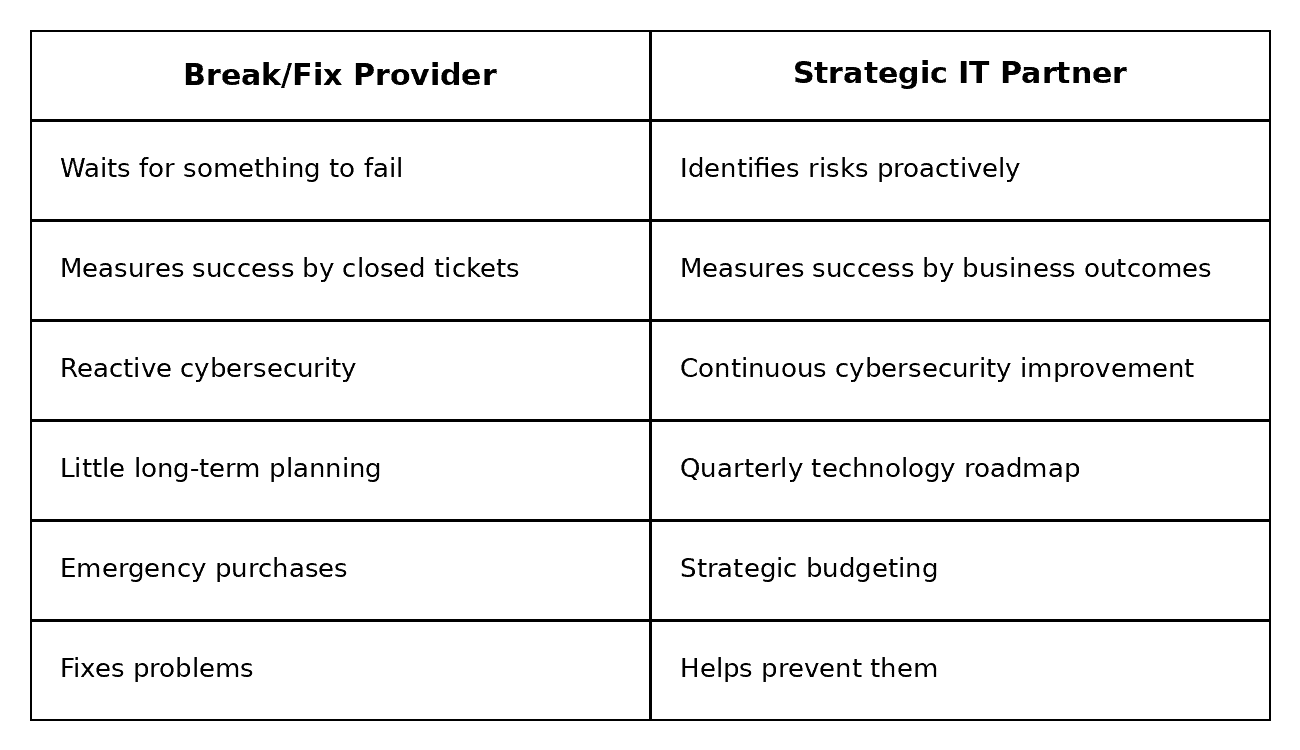
If your current provider sounds more like the left column, it may be time for a conversation.
Final Thoughts
Technology shouldn’t be managed quarter by quarter through emergencies. It should be managed through planning.
####
This article was republished with permission. To view the article as originally published click here >>






Great questions, Dale. Covers the basics and then some.