
By now, a pattern should be unmistakable. Business Continuity doesn’t fail because organizations lack standards.
It doesn’t fail because plans aren’t written. And it certainly doesn’t fail because people don’t care.
It fails when behavior under pressure diverges from what the paperwork promised.
That gap — between stated intent and lived response — is where theatre thrives. And it is exactly where building resilience either progresses or quietly erodes.
What Business Continuity leadership looks like ….
In organizations that are actively building resilience, leadership does not sit in a document, a role description, or a framework.
It shows up in behavior. It shows up in how leaders talk about risk when there is no crisis. In how trade-offs are made when resources are constrained. In whether uncomfortable truths are surfaced early or deferred politely.
You can sense it long before you try to measure it. Organizations that build resilience don’t wait for disruption to discover who decides, who escalates, or what really matters. They already know — because those behaviors are reinforced daily.
The human signals that matter most …
If you want to understand how effectively an organization is building resilience, stop looking at BC artefacts and start watching people.
Watch what happens when assumptions are challenged. Notice whether leaders reward curiosity or penalize inconvenience. Listen for whether risk is discussed honestly, or abstractly. Pay attention to how decisions are made under mild pressure — because that is how they will be made under severe pressure.
Building resilience is visible in whether people feel safe saying “this won’t work”, whether trade-offs are named explicitly, and whether leadership accepts that uncertainty cannot be eliminated — only managed.
These are cultural signals. And they matter far more than compliance.
Culture is not static — and neither is resilience.
One of the most damaging ideas in Business Continuity is the belief that resilience is an end state. Something you “achieve”, assess, and then maintain. It isn’t.
Building resilience is a living system. It shifts as strategy shifts. It strengthens or erodes as incentives change. It is constantly shaped by leadership behavior, operational pressure, and organizational memory. Every restructure changes it. Every cost decision influences it. Every leadership transition reshapes it.
The question is never “are we resilient?” The question is “how are we building resilience right now — and what are we trading off to do so?”
The future role of the BC specialist is changing
This is where the profession itself must evolve. The future Business Continuity specialist will not create value by being the best interpreter of standards. GenAI has already commoditized that capability.
Value will come from something else entirely.
From translating resilience into language that resonates with different audiences — executives, middle managers, operators, Boards. From embedding resilience thinking into leadership behavior, decision-making, and strategy — not bolting it on afterwards. From understanding the organization well enough to spot where pressure is quietly accumulating.
And from being trusted.
The “2am friend” test …
Organizations that are serious about building resilience share one trait that rarely appears in frameworks. They know exactly who they would call at 2am. Not because that person has the best plan — but because they bring clarity under pressure. They reduce noise. They ask the right questions. They help leaders think, not panic.
That is the future benchmark for Business Continuity leadership.
Not “did you comply?” But “did you help us make better decisions when it mattered?”
- Sometimes that means slowing things down.
- Sometimes it means saying “we don’t know yet”.
- Sometimes it means naming trade-offs no one wants to own.
None of that is comfortable. All of it is essential to building resilience.
Building resilience requires hard conversations.
If this series has argued anything consistently, it’s this:
Building resilience is uncomfortable by design.
It demands conversations that do not resolve neatly. It forces leaders to sit with uncertainty. It exposes contradictions between ambition and capacity. And it requires people — particularly those in BC roles — to hold tension rather than smooth it away.
This is not administrative work. It is leadership work.
The value we deliver must shift.
Business Continuity leadership will demand more from us in the years ahead. More judgement. More courage. More comfort operating without certainty. The value we deliver will no longer sit in reassurance. It will sit in enabling readiness.
In continuously reinforcing the value of building resilience — internally and externally. In strengthening credibility through insight rather than documentation. In helping organizations understand themselves honestly, even when the answers are inconvenient.
The end of theater!
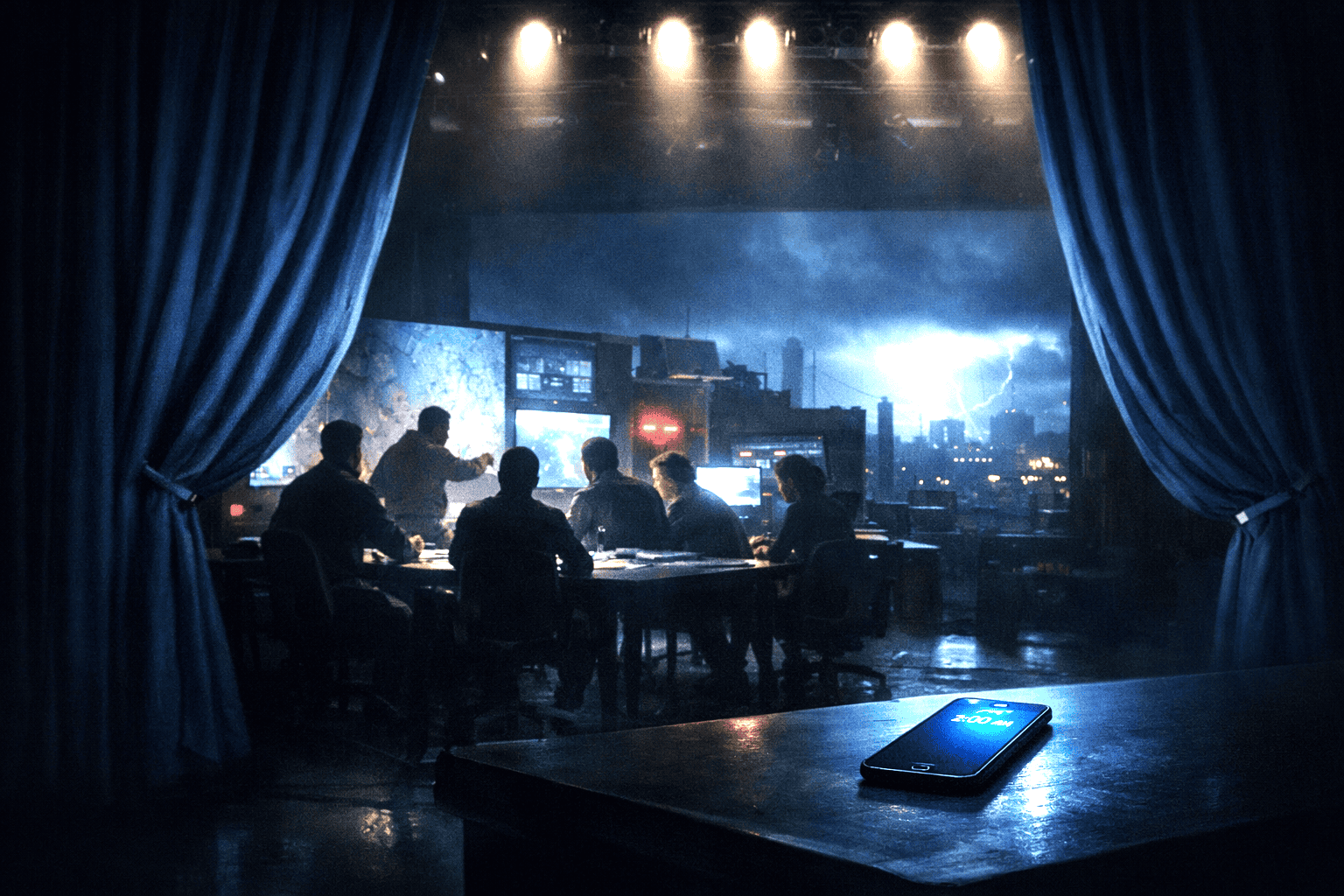
Theater works while the lights are on. But disruption doesn’t care how good the performance looked, how current the plans were, or how green the dashboard felt.
When the lights go out, only behavior remains. And that — not the framework, not the plan, not the audit — is what building resilience has always been about.





Leave A Comment
You must be logged in to post a comment.