
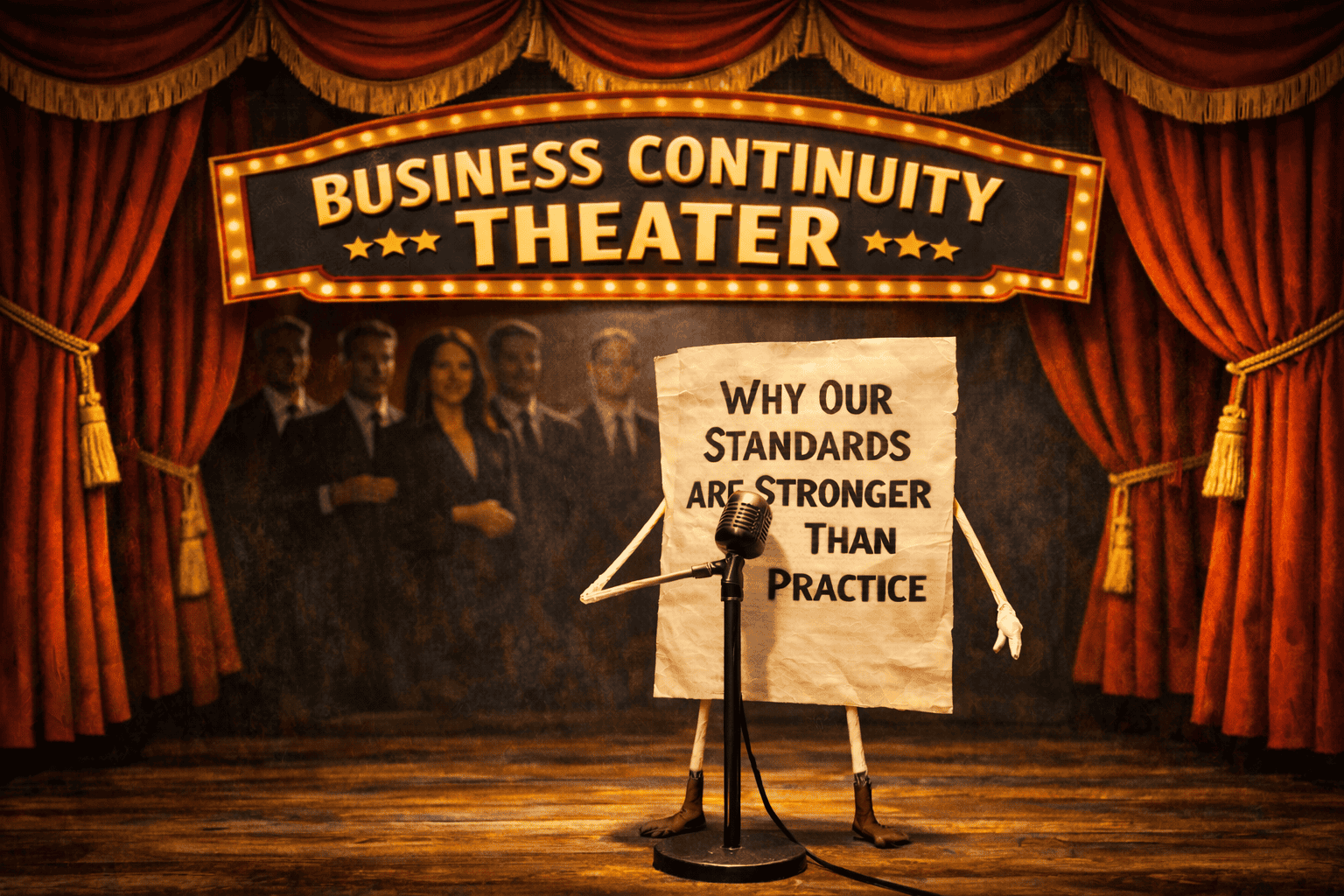
There is no shortage of guidance on how to “do” Business Continuity well.
Between ISO 22301 and the BCI Good Practice Guidelines, we have mature, globally recognized frameworks that clearly describe leadership accountability, strategic alignment, and the behaviors required to build organizational resilience.
And yet, across sectors, public/government and geographies, the same pattern persists:
- Plans exist, but confidence is misplaced
- Programs comply, but don’t adapt
- Metrics improve, while real exposure quietly grows
This overview launches a six-part series which starts from a simple observation: the gap in Business Continuity has never been technical — it is human.
This is Not a Standards Problem.
It’s tempting to treat weak BC outcomes as a failure to “meet the standard”:
- The policy isn’t complied with
- The size and scope of the program isn’t defined
- The plans aren’t detailed enough
But that diagnosis misses the point.
Most organizations can meet the obligations of ISO 22301 or the GPG. What they struggle with is what those obligations demand of people. The standards assume:
- Leaders will make explicit trade-offs that values resilience.
- Managers will surface uncomfortable truths in environments that reward silence
- Teams will challenge legacy assumptions when those assumptions are so embedded they are no longer seen.
- Risk will be discussed honestly, not abstractly
Those are not procedural tasks. They are behavioral ones.
The Human Drivers Sit Beneath the Framework.
When BC programs stall, calcify, or become performative, the causes are rarely documented anywhere — but they are predictable:
- Cognitive shortcuts: “This is what we’ve always done” becomes a substitute for reassessment.
- Social cost: Challenging scope, assumptions, or recovery expectations carries reputational risk — especially for middle management.
- False reassurance: Completion metrics soothe anxiety without reducing exposure.
- Delegated discomfort: Strategy changes at the top, but the implications for disruption risk are pushed down the organization.
- Misplaced confidence: Non-specialists underestimate the effort required to design continuity that actually works under pressure.
None of this is malicious…. All of it is very human….. and none of it is solved by adding another template.
Why the “Work” is Undervalued….
Business Continuity, when done properly, is demanding costly work:
- It requires sustained critical thinking
- It forces prioritization under uncertainty
- It exposes dependencies people would rather not own
- It challenges narratives of control and preparedness
That work largely sits outside the executive suite — with middle managers, technical specialists, and operational leaders who are expected to deliver certainty in systems that are inherently fragile.
Yet this is also where BC is most often:
- Under-resourced
- Time-boxed
- Measured incorrectly
- Treated as documentation rather than design
The result is a program that looks credible on paper but is brittle in reality.
What this Series Will Do Differently
This is not a “how to comply” series. In the articles that follow, I will focus on:
- Where Business Continuity actually lives day to day
- Why leadership intent rarely translates into operational reality
- How culture, incentives, and reporting shape behavior
- Why risk reduction is harder — and more valuable — than plan completion
Most importantly, this series will explore why well-intentioned organizations keep reproducing the same weaknesses, even when they know better. Because until we address the human dynamics underneath our frameworks, our standards will continue to outpace our practice and the next disruption will expose the gap — whether we are ready to acknowledge it or not.
The six articles in the series tackle where the real work sits — and why it’s routinely undervalued. Read the six articles >>
- The Real Work Sits Where the Authority Doesn’t — and What We Can Do About It
- Top Management “Buy-In” Isn’t the Problem. Ownership Is
- What’s Really holding Us Back and How Change Actually Takes Root
- When Plans Are Cheap, Proof Becomes Everything
- If We Can’t Articulate Our Value, We Won’t Be Valued
- Resilience Is a Behavior — Not a Framework
###
This introduction was originally published on LinkedIn and has been republished with permission. Link to the article to join in on the discussion.
Photo credit: ChatGPT






Leave A Comment
You must be logged in to post a comment.